# Repeat table headers across PDF pages
Keep the column labels close to the rows they describe. There are two levels to this: mark the header correctly, then decide whether your HTML layout needs the PDF engine's optional pagination rule.
**Before you start:** You have a working repeated table. Make a copy of the template and prepare enough rows to fill at least three pages.
#### For Word templates
Put `{RepeatHeader}` once in the row containing the column labels. Keep the data-loop tags in the data row. Portwood removes the marker and turns the marked row into a table header during conversion.
```text
| {RepeatHeader}Name | Email |
| {#Contacts}{Name} | {Email}{/Contacts} |
```
For giant-query documents, save the template again after adding the marker so the prepared sections capture it. This marker identifies the header; it does not guarantee perfect per-page pagination in every PDF layout.
#### For HTML templates
Use a real `` for labels and `` for the repeated row. Keep both loop markers inside cells; text placed directly between table rows can be moved by an HTML editor or parser.
```html
| No. |
Name |
Email |
| {#Contacts}{RowNumber} |
{Name} |
{Email}{/Contacts} |
```
```css
.directory {
width: 100%;
border-collapse: collapse;
table-layout: fixed;
page-break-inside: auto;
}
.directory thead {
display: table-header-group;
}
.directory tr {
page-break-inside: avoid;
}
.directory th,
.directory td {
border: 0.5px solid #808080;
padding: 5px 6px;
}
```
Start with the header shown above. If the labels appear on the first page only, add the pagination rule below and generate the same document again.
#### Opt in to per-page table pagination
For a controlled HTML template, add this engine-specific rule:
```css
.directory {
-fs-table-paginate: paginate;
}
```
With that rule, the downloadable lab printed all 90 rows across four pages, repeated the column header on every page, and retained the two-line page-count footer. Inspect the second page below.
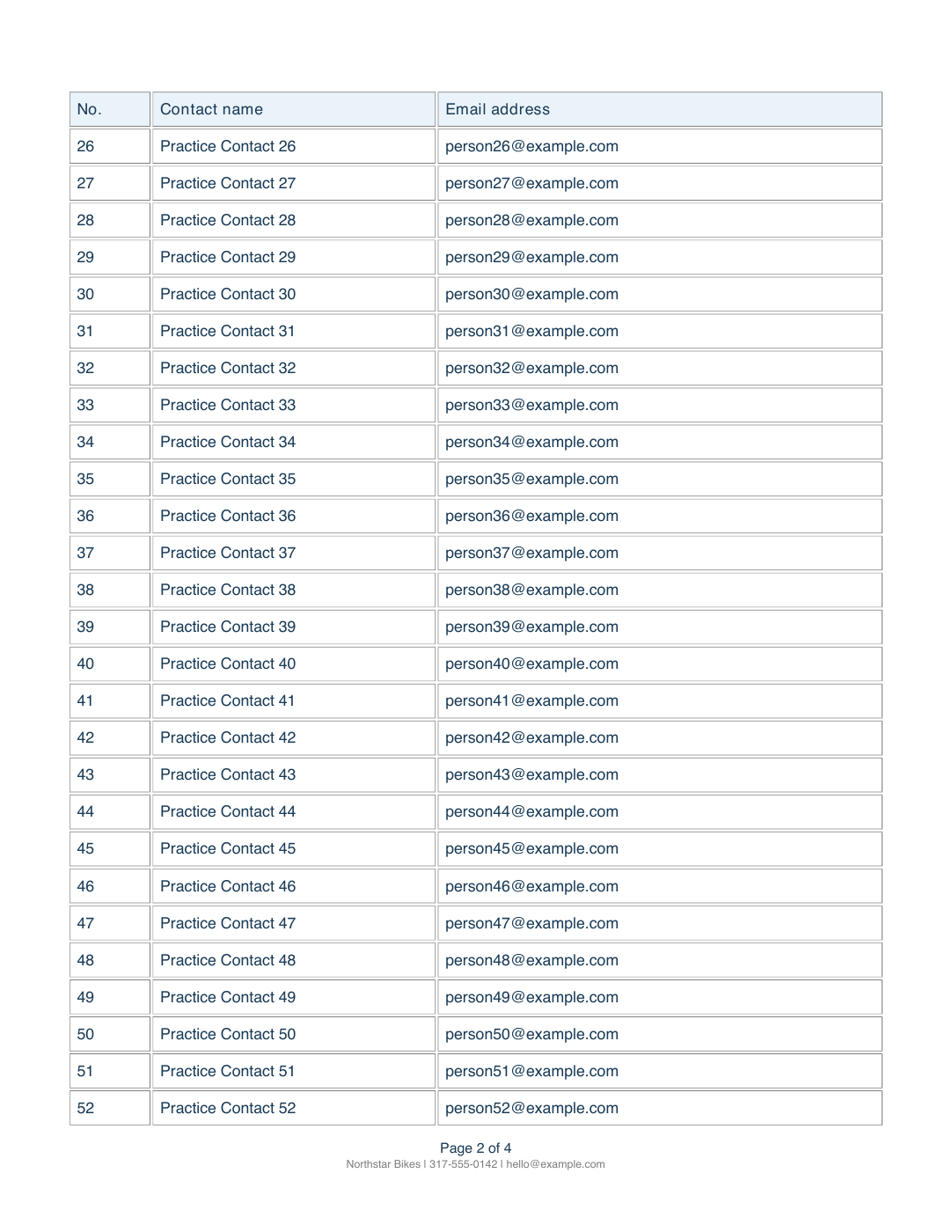
Portwood does not apply this rule to every template. Earlier layouts suffered mis-pagination with running page headers/footers and large bordered tables. Treat it as a template-specific choice: test long cells, wrapping rows, running headers, different page sizes, and the actual single, bulk, or giant-query entry point. A row taller than a page cannot be kept together simply by asking CSS to avoid a break.
#### Try the exact lab
Use the [HTML body](https://github.com/Portwood-Global-Solutions/Portwood/blob/main/docs/knowledgebase/examples/repeating-header-lab.html) and [Footer HTML](https://github.com/Portwood-Global-Solutions/Portwood/blob/main/docs/knowledgebase/examples/two-line-footer.html). The lab uses prepared `Name` and `Contacts.records` data; it does not require 90 real Contacts in your org. For normal Account queries, select the Contact fields and use the matching relationship alias.
**You are done when:** Every row appears once, labels repeat where needed, and no row or footer overlaps on any page.
The semantic-table approach was adapted from a [Portwood Community example](https://portwoodcommunity.slack.com/archives/C0AQS3BJG6L/p1790805020706859). Try the rule with your own longest table and compare it with the [multi-page service schedule](#css-print-lab).
---
Related articles
- [Build rich headers and two-line page footers](https://portwood.dev/knowledgebase/running-headers-footers.md)
- [Loops, row numbers, grouping, and scope](https://portwood.dev/knowledgebase/tag-loops.md)
- [Tune a demanding document](https://portwood.dev/knowledgebase/engine-tuning.md)
[Browse the article directory](https://portwood.dev/knowledgebase/)